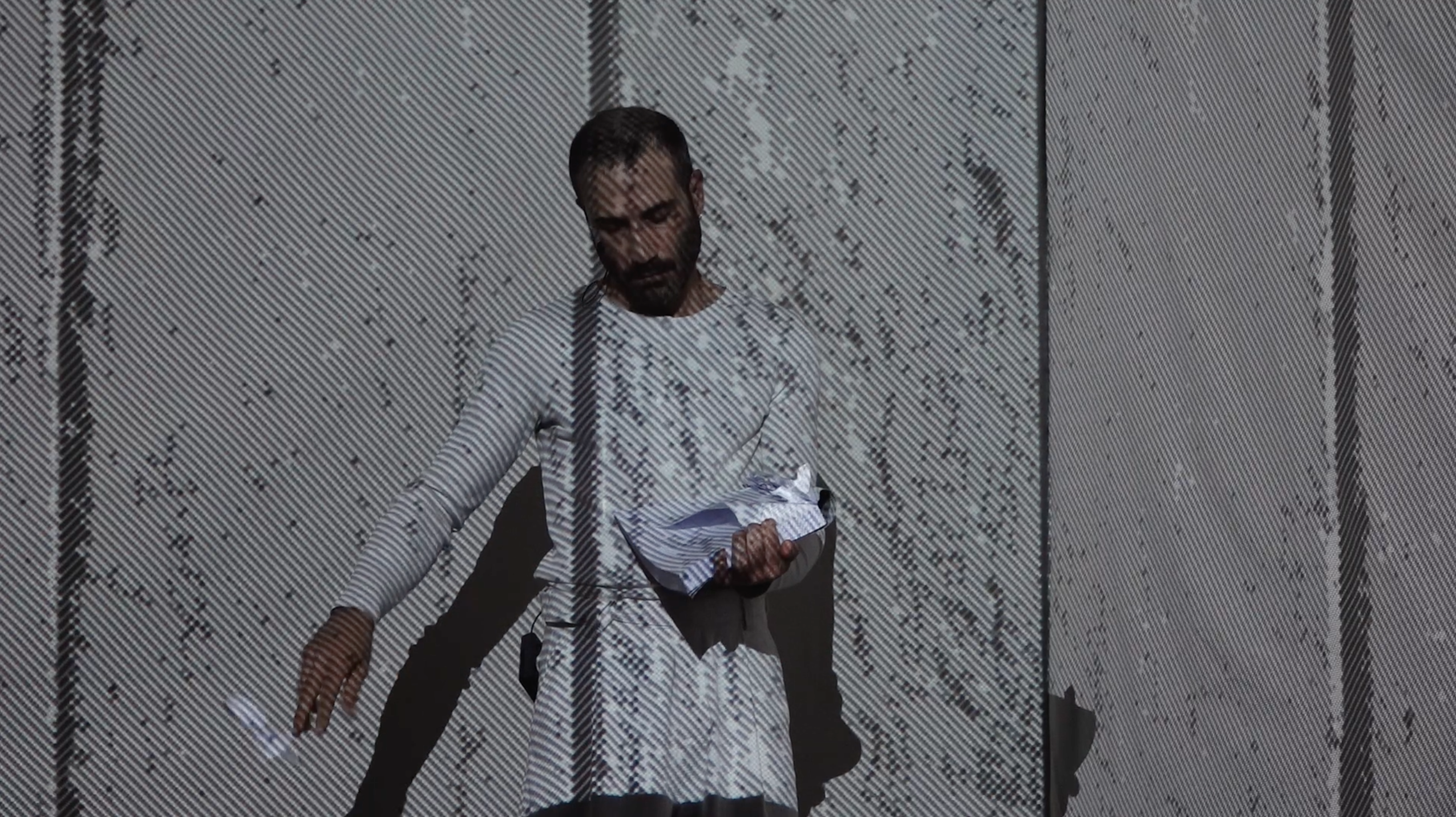
Settler Colonialism in Three Acts
A participatory lecture-performance by Mudar Al-Khufash
About the Project
Dialectics of Erasure treats settler colonialism not as a historical event but as a performance, a structure sustained daily through repeated gestures, routines, choreographed movement, and the images that organize perception, behavior, and knowledge. The work began as Al-Khufash’s master’s thesis, first staged site-specifically on Ives Street in London — the exact spot where Palestinian cartoonist Naji al-Ali was assassinated in 1987 — before being reworked over the following year for Berlin. The research behind it was undertaken during a research stay in London (winter 2024–summer 2025), supported by the Rosa Luxemburg Foundation and affiliated with the University of the Arts Berlin.
The piece sits at the intersection of performance studies, settler-colonial studies, Indigenous studies, and theories of state violence, drawing on Patrick Wolfe’s framing of settler colonialism as a structure rather than an event, and extending Richard Schechner’s performance theory by introducing resistance as an eighth function. Two further concepts run through the piece: Lewis R. Gordon’s idea of imposed temporality, colonialism as a seizure of time as much as land, and Diana Taylor’s concept of the repertoire, embodied memory carried through gesture, speech, song, and ritual, which persists through live transmission where the written archive can be destroyed.
The piece unfolds in three acts:
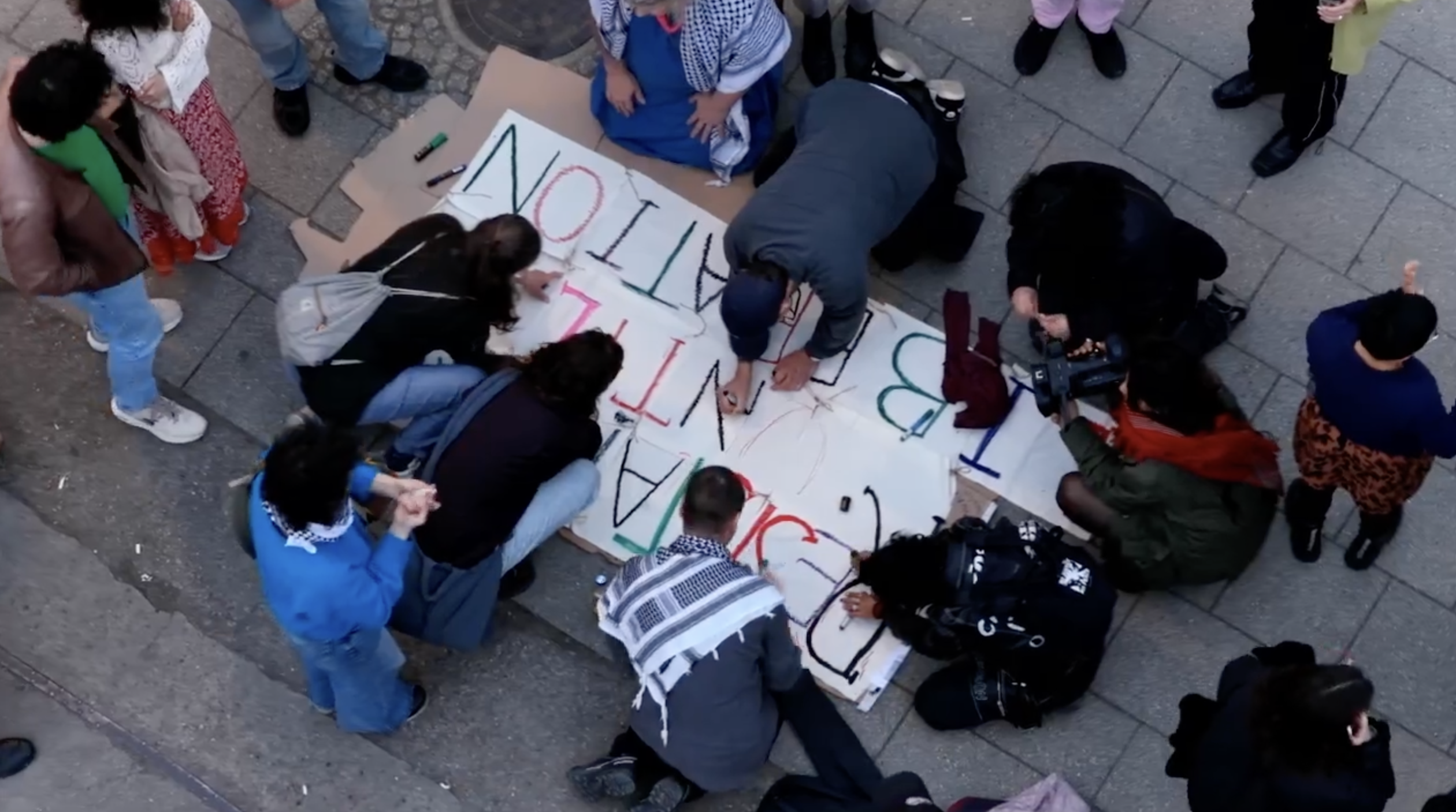
Act I — Outdoors. A site-specific public intervention. Audiences are guided through real-time collective actions, a banner-making action in a public space chosen for what it reveals about visibility, regulation, and movement. The audience votes collectively on the statement to go on the banner, then carries the finished banner toward the theatre. Participants are asked to imagine and inhabit lived realities under settler colonialism before a word of the lecture is spoken.
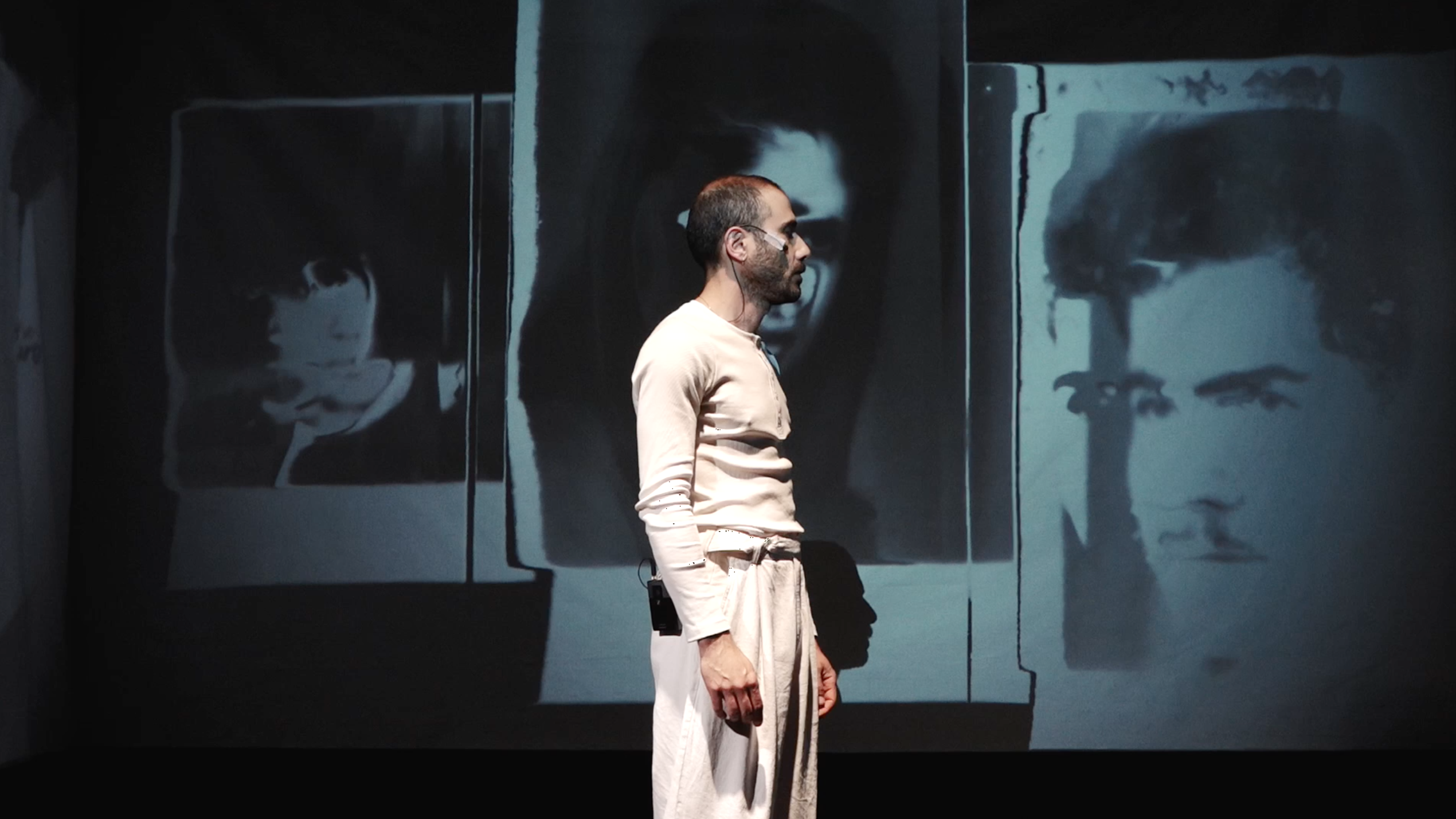
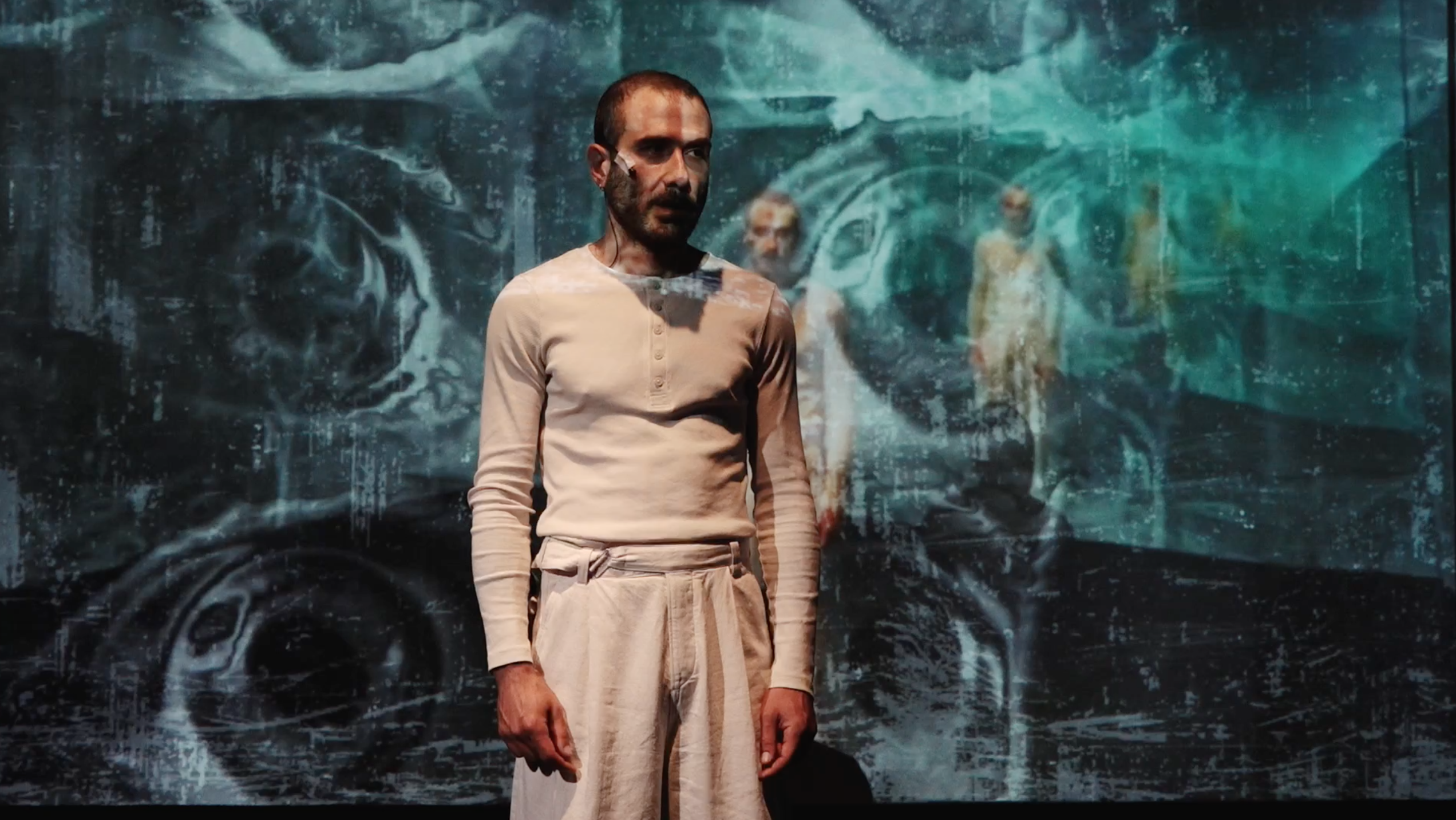
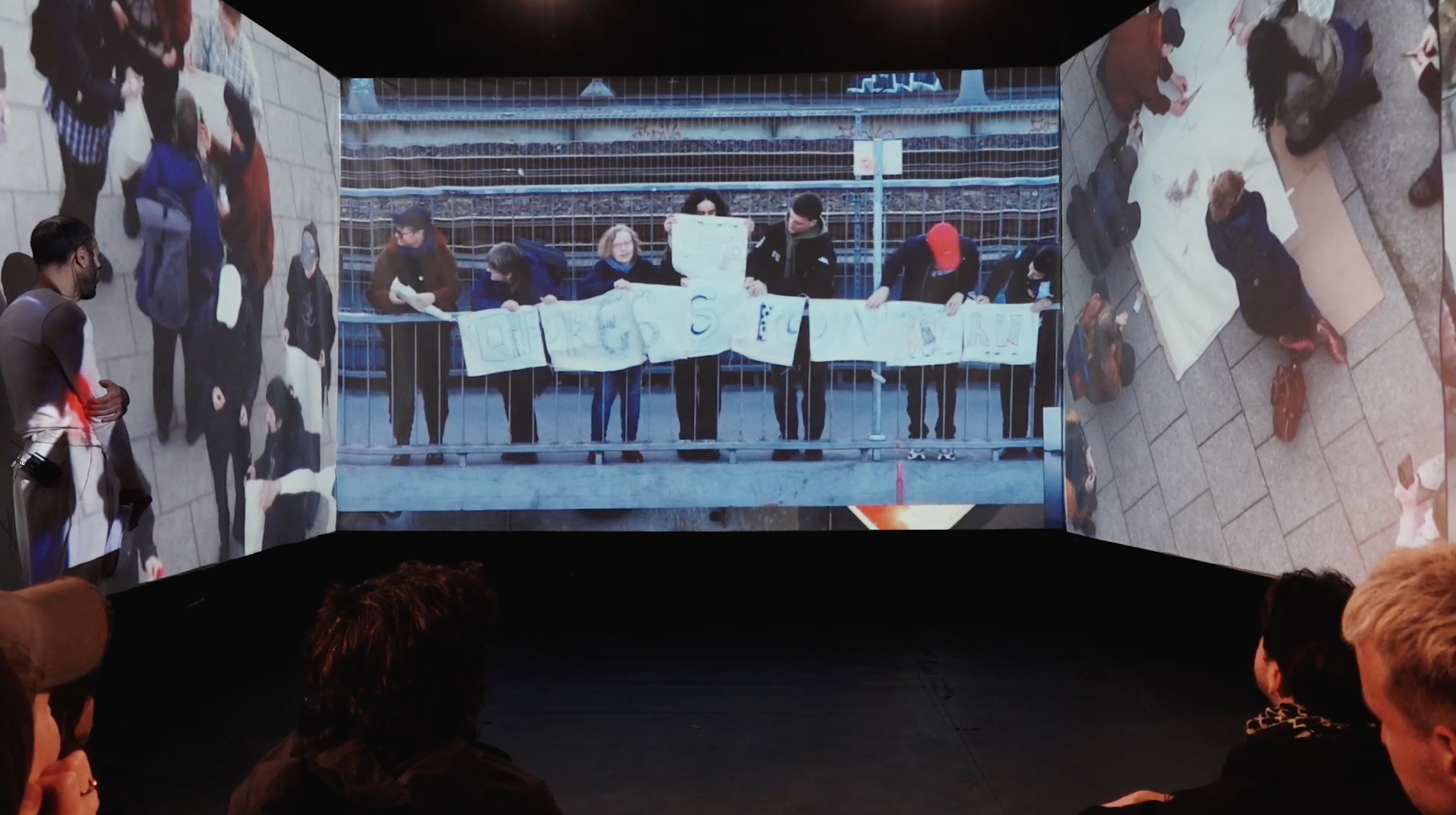
Act II — Indoors. The group moves inside, where stage speech, projected video, and extended-reality imagery examine the positions the audience has just occupied within a system of displacement, complicity, and erasure.
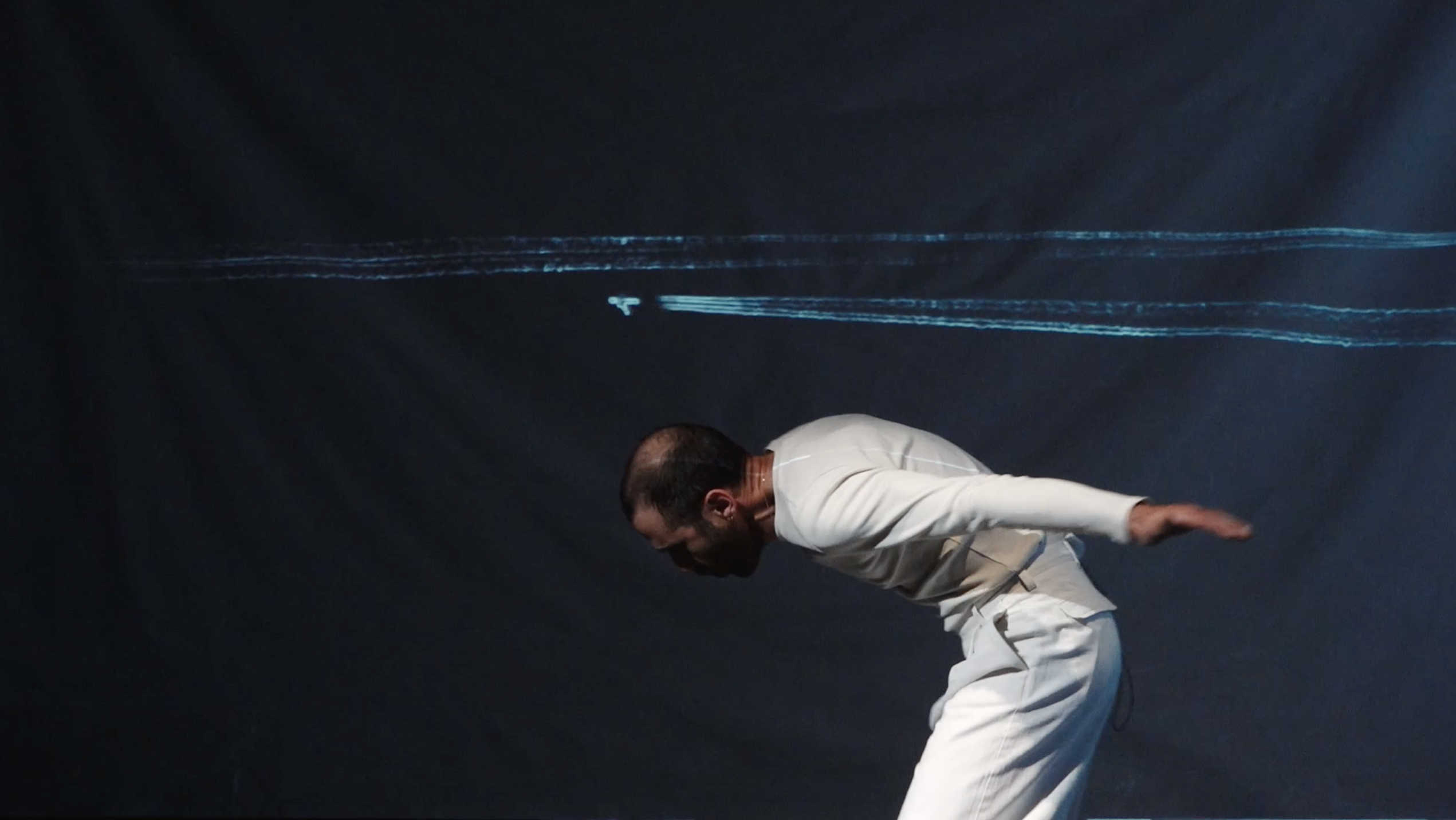
Act III — Discussion. The floor opens to the room.
Where It Has Taken Place
Berlin — Berliner Ringtheater, Alt-Stralau 68, 16–19 April 2026 Premiere. 70 minutes, in English. Gefördert durch die Senatsverwaltung für Kultur und Gesellschaftlichen Zusammenhalt des Landes Berlin.
Team: Artistic Director, Writer, Performer — Mudar Al-Khufash · Production Assistant — Andreas Tryfonopoulos · Dramaturgical Support — Lisa Kirchner, Dandan Liu · Sound Composition — Marisol Jimenez · Video Projection — Liudmila Siewerski · Movement Direction — Sefa Valentin Okutan · Mixed Reality Design — Gabriel Jeanjean · Technical Direction — Moody Kablawi · Graphic Design — Anita Nguyễn With thanks to Dan Light, Aydan Tair, Héctor Manchego, Mathew Wernham, Karina Griffith, Robert Yerachmiel Sniderman, Unity Theatre & Rosa Luxemburg Stiftung.
London — Theatre Deli, 1–2 May 2026. Production manager: Emilia Nurmukhamet with Bold Mellon Collective. The outdoor act took place on and around Leadenhall Street, in the former trading rooms whose profits, as Al-Khufash traces in the piece, were built on the transatlantic trade in cotton, tea, and enslaved people. Supported by the Art Council of England
Team: Artistic Director, Writer, Performer — Mudar Al-Khufash · Production — Emilia Nurmukhamet, Bold Mellon Collective · Dramaturgy — Dani Abulhawa · Projections Scenography — Liudmila Siewerski · Projection Mapping — Nurul Wardani and Sammy Kissin of Slice of Light · Movement Direction — Rudzani Moleya · Well-Being Support — Lubna Hoque · Technical Stage Management — Ghost Chan · Marketing — Dear Annie · Captions — Rachel Sampley
In the Press
British Theatre Guide, reviewing the Theatre Deli performance, described a piece with “rhythmic, lyrical flow” that traces a direct line from the 1917 Balfour Declaration through to the present, naming the district’s own trading history as part of that lineage — “the architecture of capital is also the architecture of erasure.” The review also documents an unplanned moment from the London run: roughly ten minutes into the performance, eight Metropolitan Police officers arrived at the venue after a member of the public reported a “Free Free Palestine” chant that had taken place during the outdoor first act. They left once told it was part of the performance — though some audience members, the reviewer noted, weren’t sure the police hadn’t been part of it too.
Reviewer Keith Mckenna closed by drawing a comparison to A Doll’s House — banned in its own time, now among the most performed plays in the world — to suggest where the struggle this piece is part of might be headed.
Read the full review: British Theatre Guide
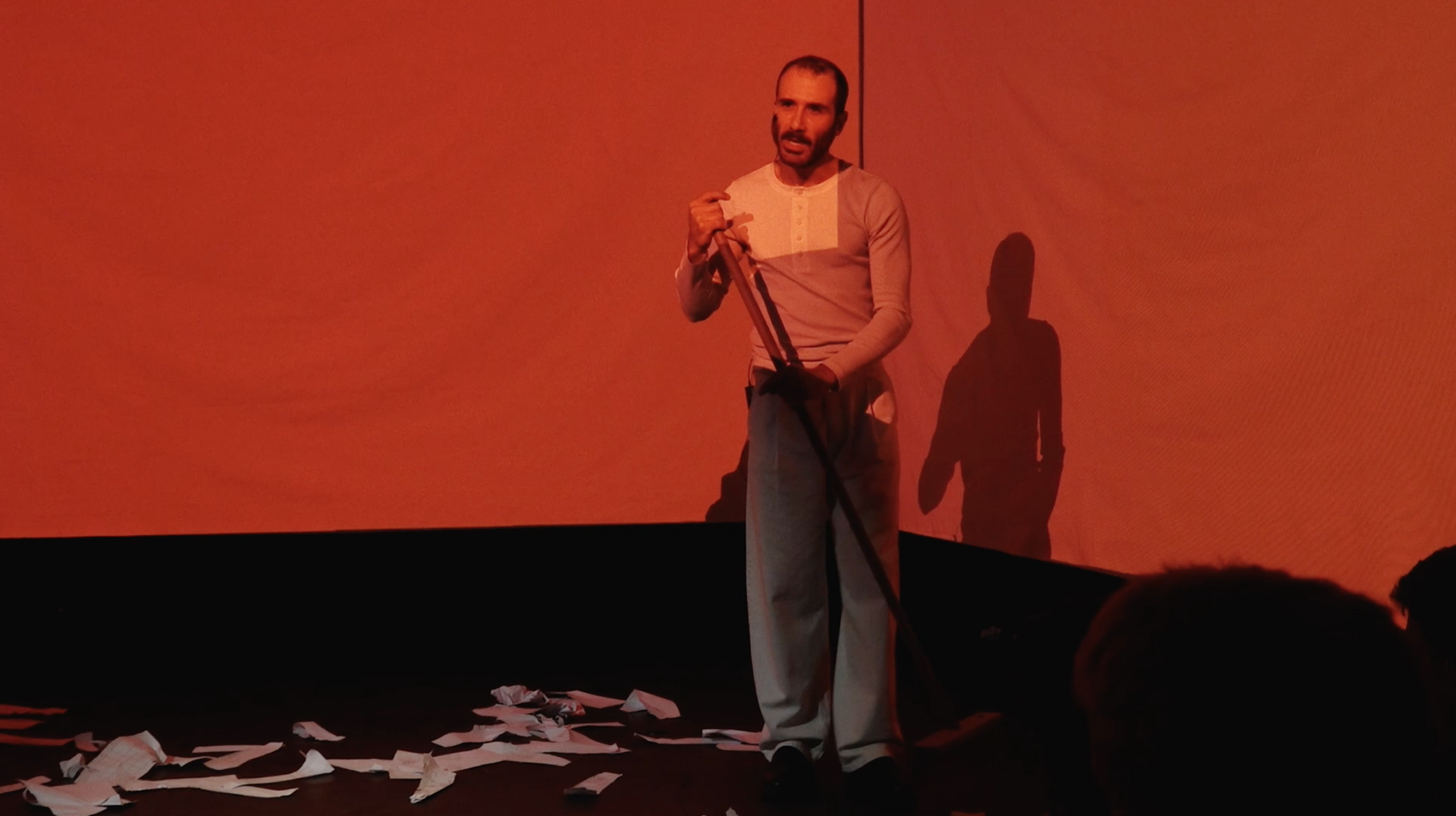
Sound Behind Curtain (★★★★), reviewing the same run, called the piece “both testimony and provocation” and traced how the pre-show banner-making action tipped into an unplanned demonstration when a passerby tried to tear the banner apart mid-walk. The disruption didn’t end at the door: minutes into the performance, police came knocking to make inquiries — an echo, reviewer Kassy Fang wrote, of the very mechanisms of erasure the piece describes on stage. The review singles out a moment drawn from Azza El-Hassan’s documentary King and Extras, in which a Palestinian refugee mother explains what she does when military planes pass overhead: “I lie down and pretend to be dead.” From there, Fang writes, the performance builds toward its central question — what does it mean to perform Palestine — closing on the image of Al-Khufash tearing the pages from his own lecture catalog and sweeping them from the stage.
Read the full review: Sound Behind Curtain

Interviews
Speaking with Contemporary Lynx after one of the London shows, Al-Khufash described the feedback from that performance as some of the strongest the project has received. That response reflects an intention he returns to throughout the interview: the piece isn’t built to deliver a conclusion. As he put it, “the archive can be burnt, but the repertoire demands presence” — the aim is for people to leave carrying the feeling, not just the argument, and to do their own thinking and research from there.
Read the full interview: Contemporary Lynx — The Politics of Visibility
Ahead of the Berlin premiere, Al-Khufash spoke with HEIST about staging the piece in a city he describes as having grown more, not less, receptive to Palestinian perspectives since October 7 — even as the wider institutional climate remains guarded. He talked through why Berlin’s production couldn’t lean on a single charged location the way London’s did on Ives Street, and how that pushed him to shift the site of erasure into the participatory game itself. On accepting Senate funding for a project like this, he was direct: “I am not censoring myself at all.” Asked about the future of Palestinian art in the city, he described it as staying precarious but irrepressible — some institutions will keep excluding it, others will fund it, and the erasure won’t stop, but neither will the presence.
Read the full interview: HEIST — “I am not censoring myself at all”
Audience Feedback
Drawn from post-show feedback forms collected after the Berlin and London performances.
Berlin
“You gave me the words and concepts I needed to express thoughts and experiences I’d been experimenting with but couldn’t shape; because of what you shared today I feel freer, and I’m deeply grateful.”
“I enjoyed very much the gradual immersion into the lecture, from a more practical act towards a more sensorial and embodied experience… I enjoyed the boldness and sensitivity. We need it.”
“The first part left me with a bitter feeling, not only because of the moment where the banner was grabbed, but because the whole gesture of giving us this cloth to write anything on felt like tokenising participation. Nevertheless, later the intention was clear, and seeing the whole thing as a projection provoked a very strong feeling… the little book with the concepts used and references is great.”
London
“The most brave, direct, yet calmly and beautifully done performance I’ve seen for the Palestinian story. It was engaging and had excellent flow for a one-man performance. The audience was very well looked after as well, this is so necessary and was also done well.”
“I am grateful that a language was found to embody this grotesque insanity we are living through. The performance challenges despair and the pack of lies we are fed constantly.”
“It was so powerful. The participatory element to make collaborators of the audience and then the injection of disruption. I found the marching in silence especially potent in setting me up for being really disregulated by the time I sat in the performance room… I also thought the Q&A at the end was a really lovely form of aftercare.”
“It was a beautiful evening. I found it informative yet poetic, open and uncomfortable as it highlighted how much I still have to learn, get deeper into, question. It woke me up.”
A recurring note in both cities: the banner-making action at the start divides opinion. Several respondents wanted more guidance for anyone who opted out of writing on the banner, and one felt the exercise risked tokenizing participation before its meaning became clear later in the piece. One London respondent also flagged that the indoor seating, camera, and access set-up felt hemmed-in rather than fully safety-conscious, despite feeling well held by the piece’s wellbeing support otherwise — worth factoring into future venue walk-throughs.
Credits
Concept, research, and performance: Mudar Al-Khufash Supported by: supported by the Senatsverwaltung für Kultur und Gesellschaftlichen Zusammenhalt des Landes Berlin, and the Art Council of England
Full Berlin and London production teams are listed above, under each venue.